










Even world leaders can be captivated by the simple charm of a rose. During his recent visit to Beijing, US President Donald Trump paused to admire Chinese roses while walking through Zhongnanhai, the historic leadership compound, alongside President Xi Jinping. The roses — growing in what was once an imperial garden — caught the attention of both leaders.
Xi told Trump that one of the trees they admired during their walk was 490 years old, and that he would send the seeds of the Chinese roses they saw in the garden to Trump as a gift. "I love that; it's great," Trump said.
This fleeting moment of shared appreciation reflects what generations have long known: the Chinese rose, or yueji,is more than a decorative plant.
From imperial gardens to neighborhood parks, these resilient, fragrant flowers embellish cultural and urban landscapes around the country, with Beijing the most famous example.
But Chinese roses are not confined to the capital's grand gardens or neighborhood parks. They are widely acknowledged by scientists as the foundation of the modern rose, one of the world's bestselling ornamental plants.
The Chinese rose has a history stretching over 2,000 years, according to the National Forestry and Grassland Administration and the National Park Administration.
Records date back to the Han Dynasty(206 BC-AD 220), but it was during the Tang (618-907) and Song (960-1279) dynasties that rose cultivation flourished. In those periods, gardeners cultivated a number of ancient, treasured varieties.
When these Chinese roses reached Europe, they sparked a horticultural revolution. European breeders crossed them with local roses, solving long-standing challenges of short flowering seasons and weak fragrances. This exchange set the stage for centuries of hybridization. Today, over 40,000 rose varieties thrive around the world, thanks largely to their Chinese predecessors.
Over the millennia, poets and scholars have celebrated the beauty of Chinese roses. Tang Dynasty poet Bai Juyiwrote, "Late to bloom after spring departs, it alone flourishes in the courtyard's heart."
Song Dynasty writer Su Shipraised the longevity of its flowering: "Peonies are rare in late spring, and peonies bloom too briefly in early summer, yet this flower blooms without end, claiming all four seasons as its own."
Ringed with floral 'necklace'
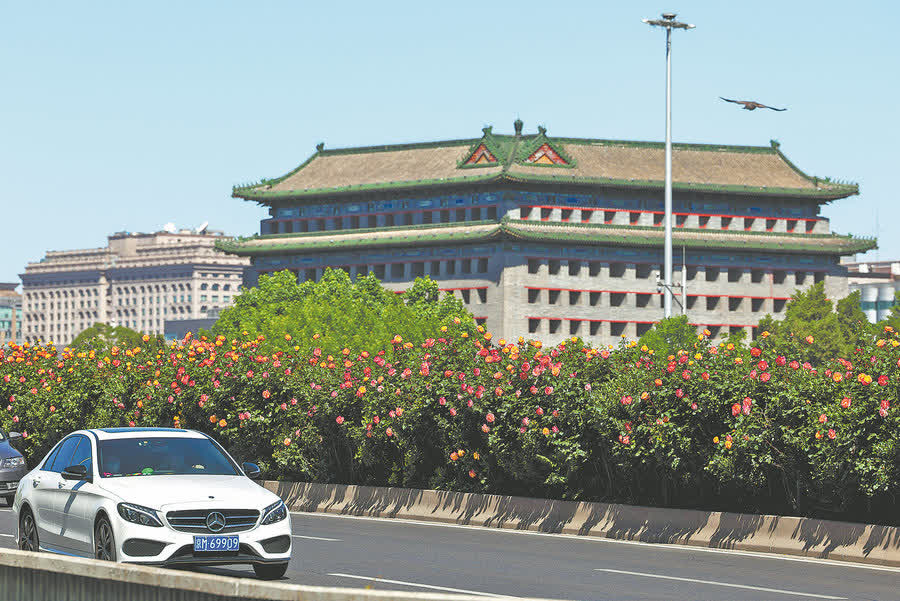
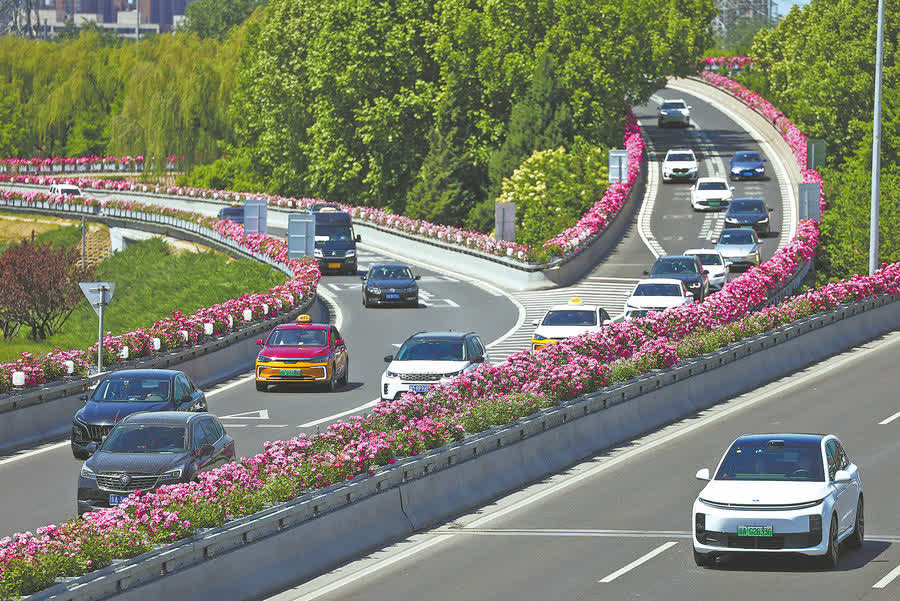
Early summer in Beijing brings a floral spectacle along the city's ring roads. Chinese roses are now in full bloom along the median strips of the Fourth Ring Road, drawing commuters to admire their vibrant colors and heady fragrance.
Social media is buzzing with posts recommending the best spots, with netizens calling the green belts "May's romantic highlight". One commuter remarked, "I usually rush home after work, but lately I stop to enjoy the flowers. The city feels more romantic."
Landscaping of the Fourth Ring Road is being upgraded this year, the Beijing Municipal Forestry and Parks Bureau said.
New rose varieties now complement the established ones, offering longer blooming cycles and more abundant flowers. The flowering season has been extended from May through late October. When completed in November, the 65.3-kilometer-long project will create a continuous "rose necklace" of an estimated 710,000 plants citywide.
In Beijing's hutongs, roses flourish — climbing walls, spilling over fences, and softening the edges of small gardens. For locals, these flowers are not a luxury; they are a familiar presence, a splash of beauty in everyday life.
Wang Meng, 38, was born and raised in the hutong area of Hufangqiao, in the southern part of the city. One of her favorite places to enjoy Chinese roses is Taoranting Park near her home.
After obtaining a master's in gardening from China Agricultural University, Wang started working at the park in 2013. She now serves as a senior engineer in landscape architecture.
"Growing up in the hutongs, Chinese roses were always around," she recalled."They're part of the neighborhood, part of our memories. This park lets me see them in full bloom, and it feels like the city itself is celebrating with me."
Established in 1952, Taoranting Park was one of the first large public parks in Beijing after the founding of the People's Republic of China in 1949.
Unlike imperial gardens, which were private and formal, Taoranting Park was intended as a place for ordinary citizens to relax, socialize and enjoy nature, earning its reputation as the "People's Park".
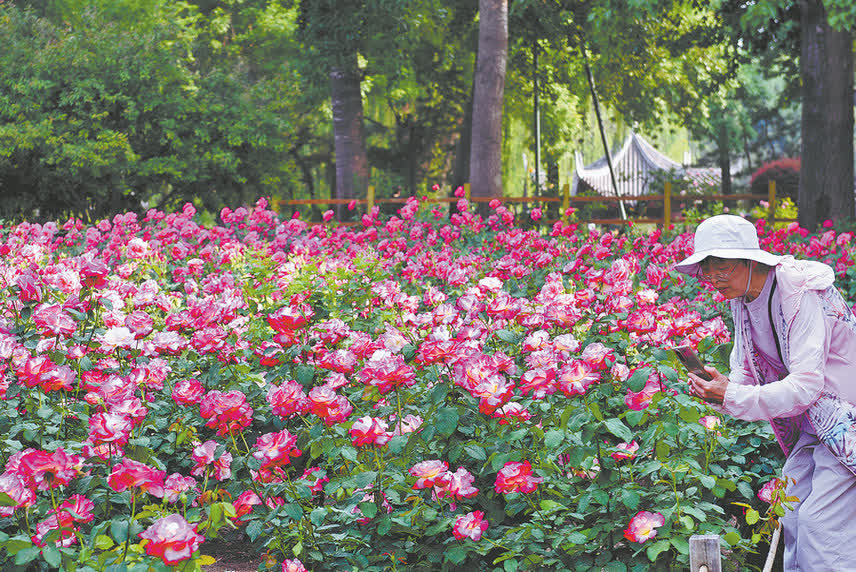
Stepping into the rose garden, known as the Shengchun Shan Fang Rose Area, feels like entering a world made entirely of colors and scents.
Wang said with more than 19,000 plants of 20 varieties, the garden is a living tapestry that constantly changes with the seasons, filling the air with layers of fragrance.
"It's not just a garden — it's a space crafted for strolling, lingering and losing oneself amid Beijing's most beloved roses," she said."Ubiquitous yet essential, Chinese roses are the subtle color running through the heart of Beijing."
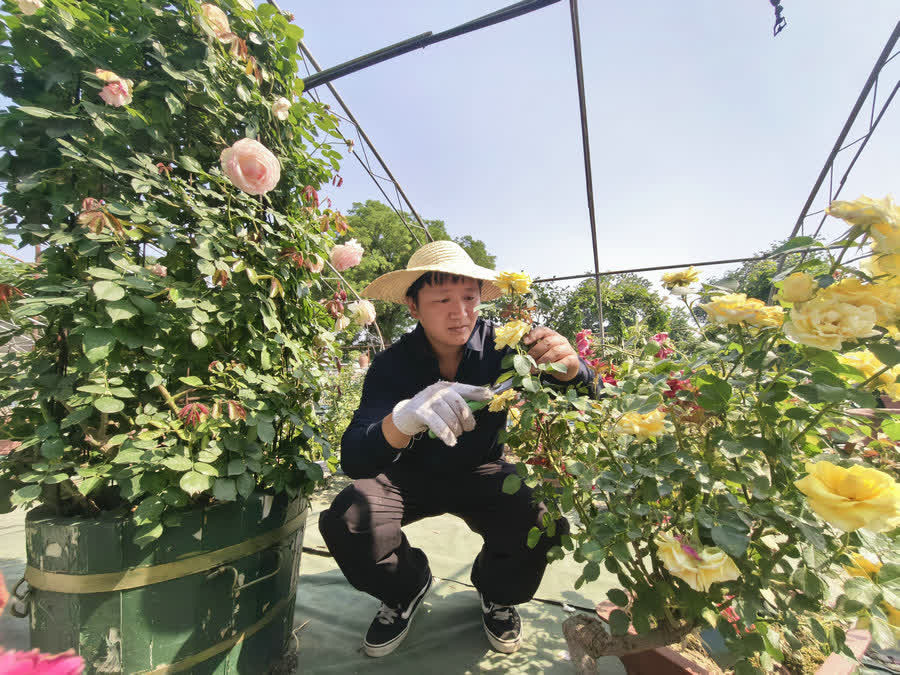
Every morning, Zhang Xin walks the paths of the rose garden, his eyes scanning almost every leaf and bud.
Zhang, 38, is a specialist in Chinese rose care. But his work doesn't end in the garden. He also spends hours in the park's greenhouse cultivation area, carefully nurturing roses according to their blooming cycles and monitoring plants. "Each plant has its own schedule, and I have to guide it patiently so that when it reaches the garden, it can shine at its best," he said.
Zhang said the most important part of tending roses isn't watering, fertilizing, or even planting, but pruning. "If you want the plant to flourish, pruning is everything," he said.
The roses are also a bridge between the gardener and visitors. Zhang loves seeing people pause on the paths, lingering over colors or inhaling the fragrant bouquets. Feedback shapes his work: some people prefer traditional blooms, others are drawn to retro or artistic varieties. Each opinion, he said, informs the garden's evolution.
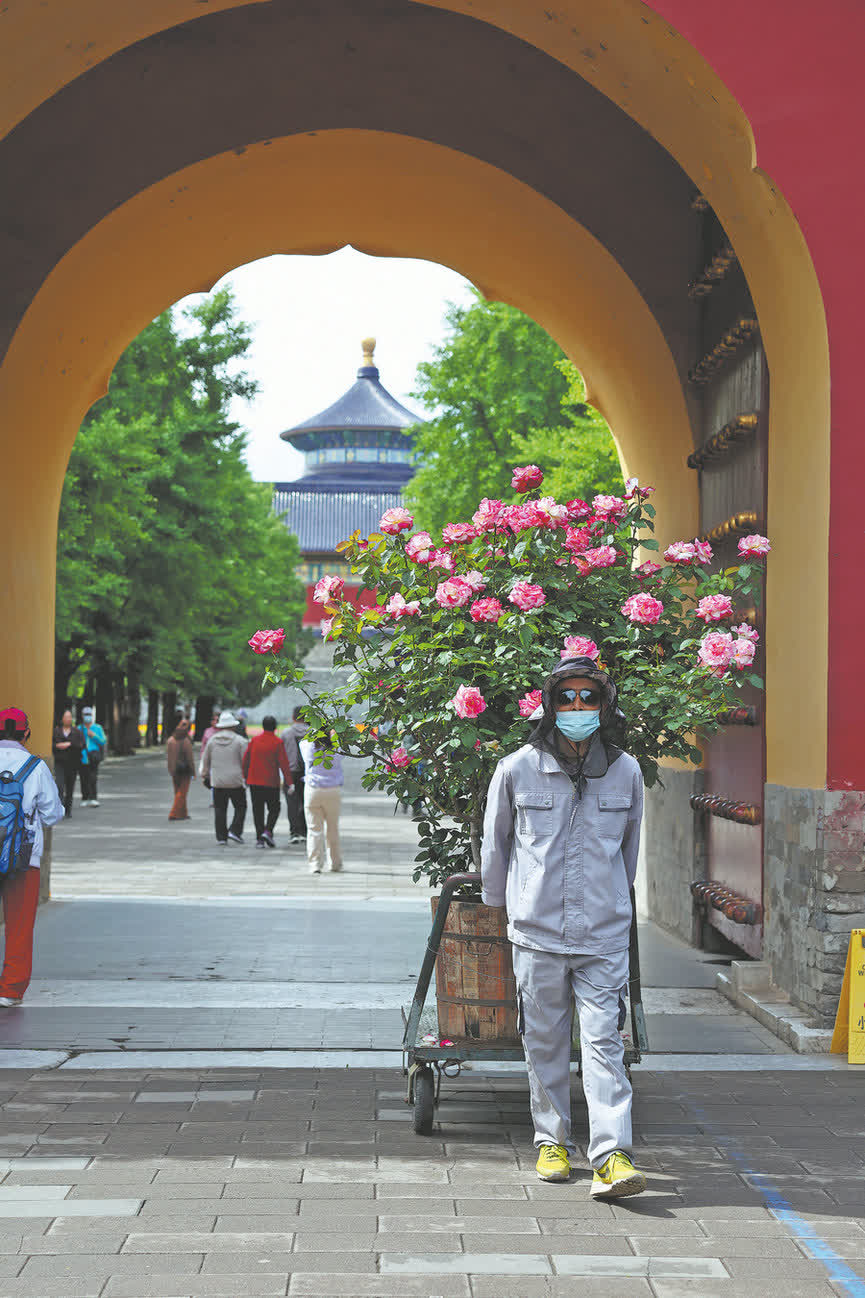
The Temple of Heaven, a short distance from Taoranting Park, boasts a vast Chinese rose garden, where blooms complement centuries-old architecture. Here, roses are not only cultivated for public enjoyment — they are entwined with ceremonial landscapes and imperial heritage.
"I come here almost every week," said Liu Mingfang, 67, who lives nearby.
"After the rain, the roses seem brighter, fresher. The light after the rain is perfect for photos," she said while taking photos of the flowers with her phone. "You can see every color in the petals. It feels alive."
When Liu was a girl, Chinese roses climbed over the courtyard walls of her home, she recalled. Seeing the roses today "feels like coming home", she said.
"Each color has its own charm. The pale pinks are delicate, the reds are bold — it lifts the spirit. Even the soft smell reminds me of my childhood."
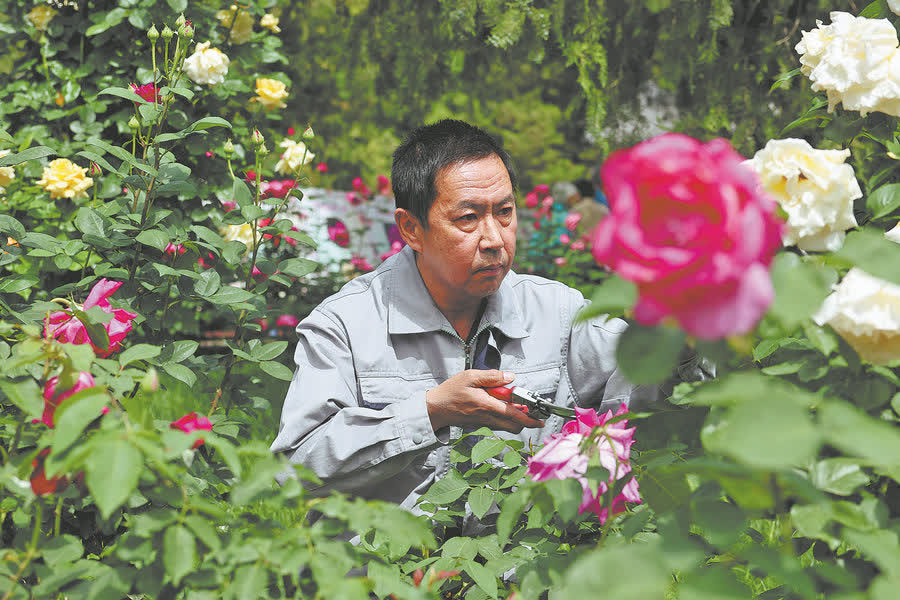
Fu Yinghui, the team leader of the Chinese rose section of the historical site's flower center, has worked at the rose garden for nearly 40 years. The story of the Temple of Heaven's rose garden started in the mid-20th century, when city planners sought to bring color and fragrance to the capital's green spaces.
The park introduced Chinese roses from southern China in 1956. In 1960, the rose garden received a significant boost when Jiang Endian, a female horticulturist affectionately known as the "Lady of Roses", returned to China from overseas and was hired as a consultant.
With her expertise, the Temple of Heaven began building a proper rose garden, selecting superior varieties and laying the groundwork for what would become one of the country's premier public rose displays.
By 1963, the rose garden spanned approximately 13,000 square meters, making it the largest open-access rose garden in China at the time. In May of that year, the park welcomed its very first rose season, with the grounds filled with the colors and sweet smells of the carefully cultivated blooms.
By 1966, more than 3,000 Chinese rose varieties had been planted at the Temple of Heaven site.
In 1988, aged just 17, Fu, whose father was a historic building restorer at the Temple of Heaven, joined the rose team. "In 1987, the Chinese rose, along with chrysanthemums, was officially designated one of Beijing's city flowers," he recalled. "Roses were becoming incredibly popular — so many varieties, such vivid colors, and so versatile in how they could be cultivated and displayed. I happened to start my career at the perfect time."
With large-scale promotion and planting in the early 1990s, roses began appearing across the city.
"Before that, roses were considered high-end flowers — too costly for urban landscaping. Streets were mostly lined with pansies or scarlet sage. During the 1990 Asian Games, the streets began to bloom with bright, beautiful roses. Slowly, they became a part of people's everyday lives and even their homes," Fu said.
In harmony with history
Beyond symbolism, the rose is remarkably adaptable. Easy to propagate and resilient to cold, drought, and challenging environments, it thrives across much of China and many parts of the world.
In Beijing, the Chinese rose has found a fitting home. Blooming from late spring to early winter — and sometimes even braving the first snow — the flowers mirror the city's enduring spirit.
Known as Yueyuehong (red every month), Chinese roses at the Temple of Heavenbloom in May and repeat at least two times more. Today, thanks to skillful cultivation, they can even thrive through autumn and winter.
Fu makes this possible with precision and patience.
Early bloomers are placed in warmer areas; after leaves appear, they are moved for optimal sunlight. Buds are trimmed to synchronize their growth with others, while overly prolific stems are pared down to concentrate nutrients on the strongest flowers. Every pot receives a balanced water and fertilizer mix, with temperature and humidity closely monitored.
"The secret," Fu said, "is not just care — it's guiding the roses to bloom beautifully, exactly when they should."
Fu said viewing the roses at the Temple of Heaven is a different experience from any other park.
Here, the blooms unfold against a backdrop of towering ancient cypresses and ginkgo trees, some hundreds of years old, their twisted trunks and sweeping branches carrying the weight of history. Beyond the greenery, the crimson and gold roofs of the temple halls rise gracefully, their ornate eaves and carved beams adding a sense of grandeur and timelessness.
Visitors wander along winding paths that curve around these venerable trees and historic structures, pausing to admire not just the roses but the harmony between cultivated beauty and the enduring architecture of imperial China. Here, every bloom seems to carry a story, not only of nature but of centuries of human care and cultural legacy.
Every morning at seven, Fu arrives at the rose garden. He takes a moment to watch the visitors as they wander among the blooms, smiling at their delight.
"It's wonderful to see everyone enjoying them. Flowers like these aren't just for beauty — they make people slow down, breathe, and remember what's good in life," he said.