












As China continues to make breakthroughs in frontier technologies, its high-quality development is moving beyond traditional measures of scale and growth toward making more tangible improvements in people's everyday lives, experts and industry leaders said during this year's Zhongguancun Forum, which concluded on Sunday in Beijing.
A number of major technological achievements unveiled during the forum offered more than a glimpse of scientific progress — they served as a preview of future lifestyles, showing how innovation is steadily moving from laboratories into real-world applications and reshaping how people live, work and interact, they said.
Their remarks came as 21 major scientific and technological achievements of China were released during the forum's closing news conference on Sunday, spanning key areas from frontier science and industry upgrade to public health and human sustainable development.
"Technological innovation does not stop in the laboratory; it must take root in production lines and in real-world applications," said Zhang Dongling, an official from the Beijing Municipal Science and Technology Commission.
Zhang noted that the latest breakthroughs highlight a clear push to integrate technological and industrial innovation, accelerating the development of new quality productive forces.
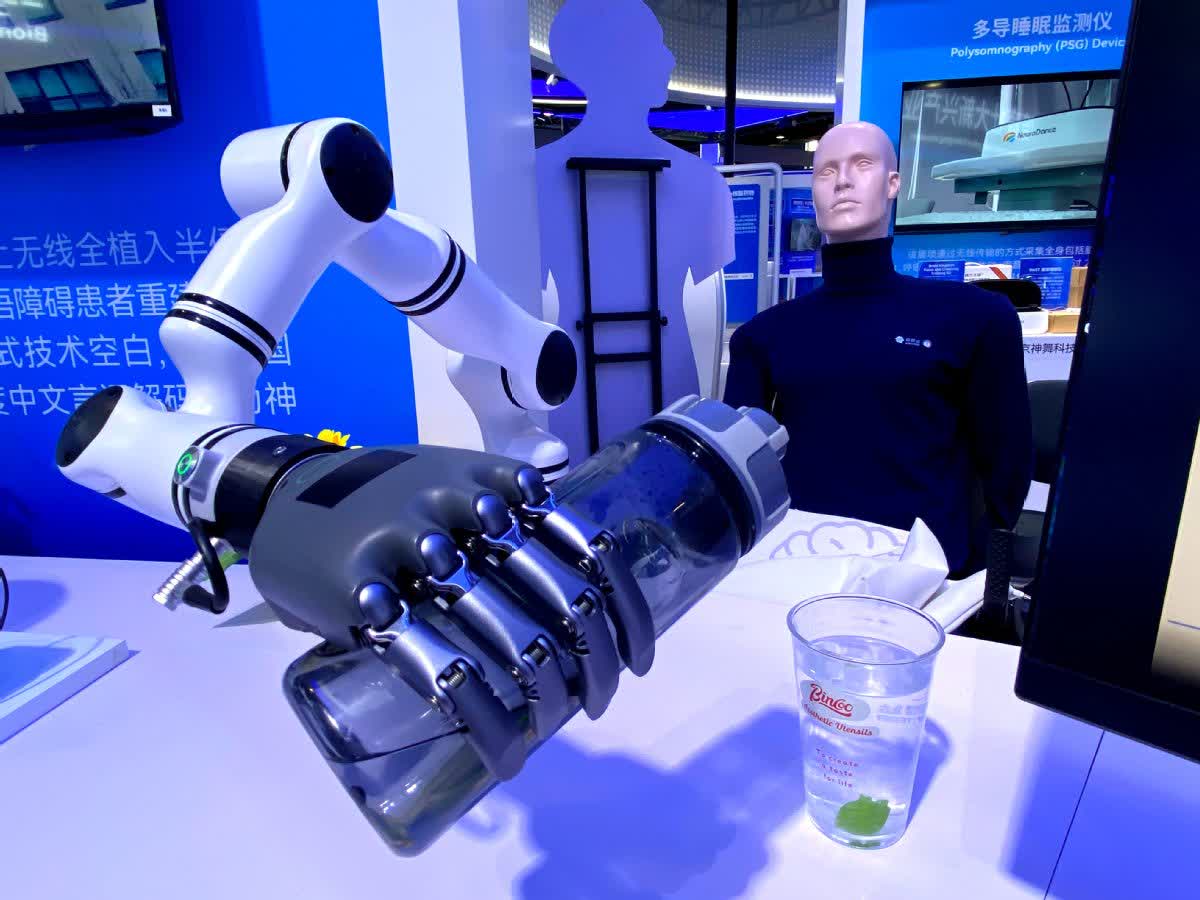
Among the highlights from the field of public health was the Beinao-1 semi-invasive brain-computer interface system. Implanting microelectrodes and a coin-sized device on the brain surface can help paralyzed patients to control exoskeletons for movement, or help those with speech impairments regain the ability to speak, the official said.
In another brain science breakthrough, a research team from Changping Laboratory in Beijing has, for the first time globally, identified the core pathological circuit of Parkinson's disease. The discovery is expected to pave the way for more effective and affordable therapies for over 5 million Parkinson's patients in China.
"We have developed a personalized, precise and noninvasive neuromodulation solution that can deliver effective treatment with higher patient acceptance," said Liu Hesheng, chief scientist of the brain and neurodegenerative diseases department at Changping Laboratory.
"More important, this framework could also be extended to treat other brain disorders, such as Alzheimer's disease, depression and autism, offering broad application prospects," Liu added.
Beyond healthcare, the forum also showcased a range of technologies closely tied to everyday life, showing how cutting-edge technologies, such as artificial intelligence, are lowering barriers to creativity and accessibility.
"If traditional music platforms connect songs, artists and audiences, AI-driven platforms will connect creativity, content generation, editing, distribution and expression," said Cheng Yu, chief scientist at domestic AI tech firm Kunlun Tech.
"With AI technologies, we hope to turn music from a professional skill into a language of expression for everyone," Cheng said, adding that Kunlun Tech unveiled a new suite of AI generated content models covering gaming, video and music during the forum, aiming to lower the cost of content creation and enable broader participation.
AI-powered smart glasses deployed at the forum further illustrated how innovation is enhancing real-world interactions. Developed by Beijing-based LLVISION, an AI and artificial reality technology company focused on smart glasses, the system supports real-time translation in 54 languages with less than one-second latency and up to eight hours of battery life.
In fact, the glasses are designed not only to enhance conference interpretation, but also to advance global accessibility by supporting users with hearing impairments.
For instance, in noisy environments, features such as intelligent sound recognition and name-based activation allow the device to alert users when their names are called, making it easier for hearing-impaired individuals to navigate public settings such as hospitals and government service counters, said Wu Fei, founder and CEO of LLVISION.
"We aim to bridge communication gaps caused by speech barriers and improve accessibility through cutting-edge technologies," Wu added. "They can also help reinforce professional support for the hearing impaired in public services."
Dai Xin, vice-dean of the Law School at Peking University, said: "China's approach to AI development is people-centered and application-driven. The focus is on delivering tangible gains, so that people can truly feel the real value of technological progress."