
大公社評英譯/香港法治堅不可摧 西方干預自取其辱
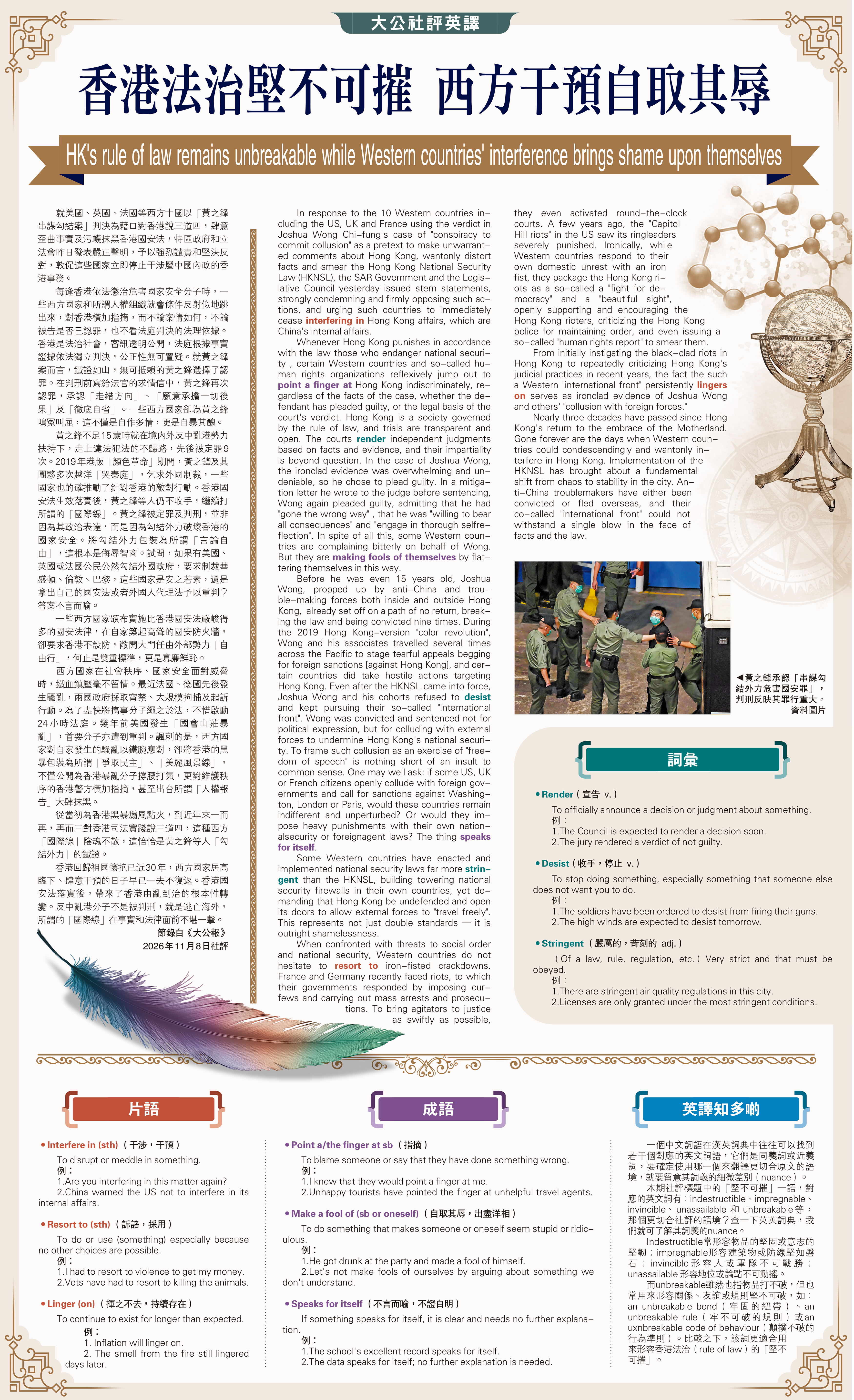
就美國、英國、法國等西方十國以「黃之鋒串謀勾結案」判決為藉口對香港說三道四,肆意歪曲事實及污衊抹黑香港國安法,特區政府和立法會昨日發表嚴正聲明,予以強烈譴責和堅決反對,敦促這些國家立即停止干涉屬中國內政的香港事務。
每逢香港依法懲治危害國家安全分子時,一些西方國家和所謂人權組織就會條件反射似地跳出來,對香港橫加指摘,而不論案情如何,不論被告是否已認罪,也不看法庭判決的法理依據。香港是法治社會,審訊透明公開,法庭根據事實證據依法獨立判決,公正性無可置疑。就黃之鋒案而言,鐵證如山,無可抵賴的黃之鋒選擇了認罪。在判刑前寫給法官的求情信中,黃之鋒再次認罪,承認「走錯方向」、「願意承擔一切後果」及「徹底自省」。一些西方國家卻為黃之鋒鳴冤叫屈,這不僅是自作多情,更是自暴其醜。
黃之鋒不足15歲時就在境內外反中亂港勢力扶持下,走上違法犯法的不歸路,先後被定罪9次。2019年港版「顏色革命」期間,黃之鋒及其團夥多次越洋「哭秦庭」,乞求外國制裁,一些國家也的確推動了針對香港的敵對行動。香港國安法生效落實後,黃之鋒等人仍不收手,繼續打所謂的「國際線」。黃之鋒被定罪及判刑,並非因為其政治表達,而是因為勾結外力破壞香港的國家安全。將勾結外力包裝為所謂「言論自由」,這根本是侮辱智商。試問,如果有美國、英國或法國公民公然勾結外國政府,要求制裁華盛頓、倫敦、巴黎,這些國家是安之若素,還是拿出自己的國安法或者外國人代理法予以重判?答案不言而喻。
一些西方國家頒布實施比香港國安法嚴峻得多的國安法律,在自家築起高聳的國安防火牆,卻要求香港不設防,敞開大門任由外部勢力「自由行」,何止是雙重標準,更是寡廉鮮恥。
西方國家在社會秩序、國家安全面對威脅時,鐵血鎮壓毫不留情。最近法國、德國先後發生騷亂,兩國政府採取宵禁、大規模拘捕及起訴行動。為了盡快將搞事分子繩之於法,不惜啟動24小時法庭。幾年前美國發生「國會山莊暴亂」,首要分子亦遭到重判。諷刺的是,西方國家對自家發生的騷亂以鐵腕應對,卻將香港的黑暴包裝為所謂「爭取民主」、「美麗風景線」,不僅公開為香港暴亂分子撐腰打氣,更對維護秩序的香港警方橫加指摘,甚至出台所謂「人權報告」大肆抹黑。
從當初為香港黑暴煽風點火,到近年來一而再,再而三對香港司法實踐說三道四,這種西方「國際線」陰魂不散,這恰恰是黃之鋒等人「勾結外力」的鐵證。
香港回歸祖國懷抱已近30年,西方國家居高臨下、肆意干預的日子早已一去不復返。香港國安法落實後,帶來了香港由亂到治的根本性轉變。反中亂港分子不是被判刑,就是逃亡海外,所謂的「國際線」在事實和法律面前不堪一擊。
節錄自《大公報》
2026年11月8日社評
HK's rule of law remains unbreakable while Western countries' interference brings shame upon themselves
In response to the 10 Western countries including the US, UK and France using the verdict in Joshua Wong Chi-fung's case of "conspiracy to commit collusion" as a pretext to make unwarranted comments about Hong Kong, wantonly distort facts and smear the Hong Kong National Security Law (HKNSL), the SAR Government and the Legislative Council yesterday issued stern statements, strongly condemning and firmly opposing such actions, and urging such countries to immediately cease interfering in Hong Kong affairs, which are China's internal affairs.
Whenever Hong Kong punishes in accordance with the law those who endanger national security , certain Western countries and so-called human rights organizations reflexively jump out to point a finger at Hong Kong indiscriminately, regardless of the facts of the case, whether the defendant has pleaded guilty, or the legal basis of the court's verdict. Hong Kong is a society governed by the rule of law, and trials are transparent and open. The courts render independent judgments based on facts and evidence, and their impartiality is beyond question. In the case of Joshua Wong, the ironclad evidence was overwhelming and undeniable, so he chose to plead guilty. In a mitigation letter he wrote to the judge before sentencing, Wong again pleaded guilty, admitting that he had "gone the wrong way" , that he was "willing to bear all consequences" and "engage in thorough selfreflection". In spite of all this, some Western countries are complaining bitterly on behalf of Wong. But they are making fools of themselves by flattering themselves in this way.
Before he was even 15 years old, Joshua Wong, propped up by anti-China and trouble-making forces both inside and outside Hong Kong, already set off on a path of no return, breaking the law and being convicted nine times. During the 2019 Hong Kong-version "color revolution", Wong and his associates travelled several times across the Pacific to stage tearful appeals begging for foreign sanctions [against Hong Kong], and certain countries did take hostile actions targeting Hong Kong. Even after the HKNSL came into force, Joshua Wong and his cohorts refused to desist and kept pursuing their so-called "international front". Wong was convicted and sentenced not for political expression, but for colluding with external forces to undermine Hong Kong's national security. To frame such collusion as an exercise of "freedom of speech" is nothing short of an insult to common sense. One may well ask: if some US, UK or French citizens openly collude with foreign governments and call for sanctions against Washington, London or Paris, would these countries remain indifferent and unperturbed? Or would they impose heavy punishments with their own nationalsecurity or foreignagent laws? The thing speaks for itself.
Some Western countries have enacted and implemented national security laws far more stringent than the HKNSL, building towering national security firewalls in their own countries, yet demanding that Hong Kong be undefended and open its doors to allow external forces to "travel freely". This represents not just double standards — it is outright shamelessness.
When confronted with threats to social order and national security, Western countries do not hesitate to resort to iron-fisted crackdowns. France and Germany recently faced riots, to which their governments responded by imposing curfews and carrying out mass arrests and prosecutions. To bring agitators to justice as swiftly as possible, they even activated round-the-clock courts. A few years ago, the "Capitol Hill riots" in the US saw its ringleaders severely punished. Ironically, while Western countries respond to their own domestic unrest with an iron fist, they package the Hong Kong riots as a so-called a "fight for democracy" and a "beautiful sight", openly supporting and encouraging the Hong Kong rioters, criticizing the Hong Kong police for maintaining order, and even issuing a so-called "human rights report" to smear them.
From initially instigating the black-clad riots in Hong Kong to repeatedly criticizing Hong Kong's judicial practices in recent years, the fact the such a Western "international front" persistently lingers on serves as ironclad evidence of Joshua Wong and others' "collusion with foreign forces."
Nearly three decades have passed since Hong Kong's return to the embrace of the Motherland. Gone forever are the days when Western countries could condescendingly and wantonly interfere in Hong Kong. Implementation of the HKNSL has brought about a fundamental shift from chaos to stability in the city. Anti-China troublemakers have either been convicted or fled overseas, and their co-called "international front" could not withstand a single blow in the face of facts and the law.
詞彙
•Render(宣告 v.)
To officially announce a decision or judgment about something.
例:
1.The Council is expected to render a decision soon.
2.The jury rendered a verdict of not guilty.
•Desist(收手,停止 v.)
To stop doing something, especially something that someone else does not want you to do.
例:
1.The soldiers have been ordered to desist from firing their guns.
2.The high winds are expected to desist tomorrow.
•Stringent(嚴厲的,苛刻的 adj.)
(Of a law, rule, regulation, etc.)Very strict and that must be obeyed.
例:
1.There are stringent air quality regulations in this city.
2.Licenses are only granted under the most stringent conditions.
片語
•Interfere in (sth) (干涉,干預)
To disrupt or meddle in something.
例:
1.Are you interfering in this matter again?
2.China warned the US not to interfere in its internal affairs.
•Resort to (sth) (訴諸,採用)
To do or use (something) especially because no other choices are possible.
例:
1.I had to resort to violence to get my money.
2.Vets have had to resort to killing the animals.
•Linger (on) (揮之不去,持續存在)
To continue to exist for longer than expected.
例:
1. Inflation will linger on.
2. The smell from the fire still lingered days later.
成語
•Point a/the finger at sb (指摘)
To blame someone or say that they have done something wrong.
例:
1.I knew that they would point a finger at me.
2.Unhappy tourists have pointed the finger at unhelpful travel agents.
•Make a fool of (sb or oneself) (自取其辱,出盡洋相)
To do something that makes someone or oneself seem stupid or ridiculous.
例:
1.He got drunk at the party and made a fool of himself.
2.Let's not make fools of ourselves by arguing about something we don't understand.
•Speaks for itself (不言而喻,不證自明)
If something speaks for itself, it is clear and needs no further explanation.
例:
1.The school's excellent record speaks for itself.
2.The data speaks for itself; no further explanation is needed.
英譯知多啲
一個中文詞語在漢英詞典中往往可以找到若干個對應的英文詞語,它們是同義詞或近義詞,要確定使用哪一個來翻譯更切合原文的語境,就要留意其詞義的細微差別(nuance)。
本期社評標題中的「堅不可摧」一語,對應的英文詞有:indestructible、impregnable、invincible、unassailable 和 unbreakable等,那個更切合社評的語境?查一下英英詞典,我們就可了解其詞義的nuance。
Indestructible常形容物品的堅固或意志的堅韌;impregnable形容建築物或防線堅如磐石;invincible形容人或軍隊不可戰勝;unassailable 形容地位或論點不可動搖。
而unbreakable雖然也指物品打不破,但也常用來形容關係、友誼或規則堅不可破,如:an unbreakable bond(牢固的紐帶)、an unbreakable rule(牢不可破的規則)或an uxnbreakable code of behaviour(顛撲不破的行為準則)。比較之下,該詞更適合用來形容香港法治(rule of law)的「堅不可摧」。
