
大公社評英譯/布局企業財資新賽道 彰顯金融優勢
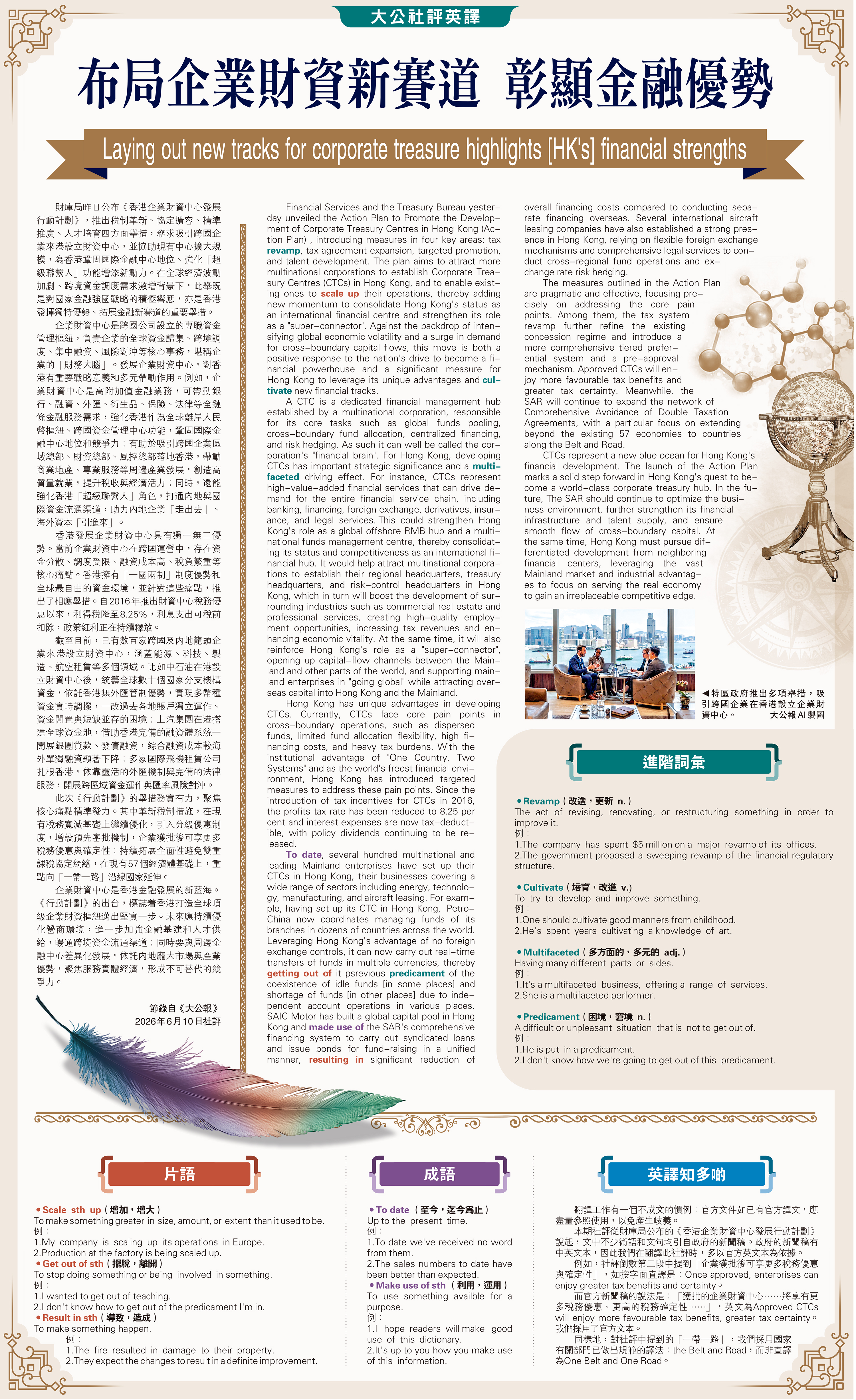
財庫局昨日公布《香港企業財資中心發展行動計劃》,推出稅制革新、協定擴容、精準推廣、人才培育四方面舉措,務求吸引跨國企業來港設立財資中心,並協助現有中心擴大規模,為香港鞏固國際金融中心地位、強化「超級聯繫人」功能增添新動力。在全球經濟波動加劇、跨境資金調度需求激增背景下,此舉既是對國家金融強國戰略的積極響應,亦是香港發揮獨特優勢、拓展金融新賽道的重要舉措。
企業財資中心是跨國公司設立的專職資金管理樞紐,負責企業的全球資金歸集、跨境調度、集中融資、風險對沖等核心事務,堪稱企業的「財務大腦」。發展企業財資中心,對香港有重要戰略意義和多元帶動作用。例如,企業財資中心是高附加值金融業務,可帶動銀行、融資、外匯、衍生品、保險、法律等全鏈條金融服務需求,強化香港作為全球離岸人民幣樞紐、跨國資金管理中心功能,鞏固國際金融中心地位和競爭力;有助於吸引跨國企業區域總部、財資總部、風控總部落地香港,帶動商業地產、專業服務等周邊產業發展,創造高質量就業,提升稅收與經濟活力;同時,還能強化香港「超級聯繫人」角色,打通內地與國際資金流通渠道,助力內地企業「走出去」、海外資本「引進來」。
香港發展企業財資中心具有獨一無二優勢。當前企業財資中心在跨國運營中,存在資金分散、調度受限、融資成本高、稅負繁重等核心痛點。香港擁有「一國兩制」制度優勢和全球最自由的資金環境,並針對這些痛點,推出了相應舉措。自2016年推出財資中心稅務優惠以來,利得稅降至8.25%,利息支出可稅前扣除,政策紅利正在持續釋放。
截至目前,已有數百家跨國及內地龍頭企業來港設立財資中心,涵蓋能源、科技、製造、航空租賃等多個領域。比如中石油在港設立財資中心後,統籌全球數十個國家分支機構資金,依託香港無外匯管制優勢,實現多幣種資金實時調撥,一改過去各地賬戶獨立運作、資金閒置與短缺並存的困境;上汽集團在港搭建全球資金池,借助香港完備的融資體系統一開展銀團貸款、發債融資,綜合融資成本較海外單獨融資顯著下降;多家國際飛機租賃公司扎根香港,依靠靈活的外匯機制與完備的法律服務,開展跨區域資金運作與匯率風險對沖。
此次《行動計劃》的舉措務實有力,聚焦核心痛點精準發力。其中革新稅制措施,在現有稅務寬減基礎上繼續優化,引入分級優惠制度,增設預先審批機制,企業獲批後可享更多稅務優惠與確定性;持續拓展全面性避免雙重課稅協定網絡,在現有57個經濟體基礎上,重點向「一帶一路」沿線國家延伸。
企業財資中心是香港金融發展的新藍海。《行動計劃》的出台,標誌着香港打造全球頂級企業財資樞紐邁出堅實一步。未來應持續優化營商環境,進一步加強金融基建和人才供給,暢通跨境資金流通渠道;同時要與周邊金融中心差異化發展,依託內地龐大市場與產業優勢,聚焦服務實體經濟,形成不可替代的競爭力。
節錄自《大公報》
2026年6月10日社評
Laying out new tracks for corporate treasure highlights [HK's] financial strengths
Financial Services and the Treasury Bureau yesterday unveiled the Action Plan to Promote the Development of Corporate Treasury Centres in Hong Kong (Action Plan) , introducing measures in four key areas: tax revamp, tax agreement expansion, targeted promotion, and talent development. The plan aims to attract more multinational corporations to establish Corporate Treasury Centres (CTCs) in Hong Kong, and to enable existing ones to scale up their operations, thereby adding new momentum to consolidate Hong Kong's status as an international financial centre and strengthen its role as a "super-connector". Against the backdrop of intensifying global economic volatility and a surge in demand for cross-boundary capital flows, this move is both a positive response to the nation's drive to become a financial powerhouse and a significant measure for Hong Kong to leverage its unique advantages and cultivate new financial tracks.
A CTC is a dedicated financial management hub established by a multinational corporation, responsible for its core tasks such as global funds pooling, cross-boundary fund allocation, centralized financing, and risk hedging. As such it can well be called the corporation's "financial brain". For Hong Kong, developing CTCs has important strategic significance and a multifaceted driving effect. For instance, CTCs represent high-value-added financial services that can drive demand for the entire financial service chain, including banking, financing, foreign exchange, derivatives, insurance, and legal services. This could strengthen Hong Kong's role as a global offshore RMB hub and a multinational funds management centre, thereby consolidating its status and competitiveness as an international financial hub. It would help attract multinational corporations to establish their regional headquarters, treasury headquarters, and risk-control headquarters in Hong Kong, which in turn will boost the development of surrounding industries such as commercial real estate and professional services, creating high-quality employment opportunities, increasing tax revenues and enhancing economic vitality. At the same time, it will also reinforce Hong Kong's role as a "super-connector", opening up capital-flow channels between the Mainland and other parts of the world, and supporting mainland enterprises in "going global" while attracting overseas capital into Hong Kong and the Mainland.
Hong Kong has unique advantages in developing CTCs. Currently, CTCs face core pain points in cross-boundary operations, such as dispersed funds, limited fund allocation flexibility, high financing costs, and heavy tax burdens. With the institutional advantage of "One Country, Two Systems" and as the world's freest financial environment, Hong Kong has introduced targeted measures to address these pain points. Since the introduction of tax incentives for CTCs in 2016, the profits tax rate has been reduced to 8.25 per cent and interest expenses are now tax-deductible, with policy dividends continuing to be released.
To date, several hundred multinational and leading Mainland enterprises have set up their CTCs in Hong Kong, their businesses covering a wide range of sectors including energy, technology, manufacturing, and aircraft leasing. For example, having set up its CTC in Hong Kong, PetroChina now coordinates managing funds of its branches in dozens of countries across the world. Leveraging Hong Kong's advantage of no foreign exchange controls, it can now carry out real-time transfers of funds in multiple currencies, thereby getting out of it psrevious predicament of the coexistence of idle funds [in some places] and shortage of funds [in other places] due to independent account operations in various places. SAIC Motor has built a global capital pool in Hong Kong and made use of the SAR's comprehensive financing system to carry out syndicated loans and issue bonds for fund-raising in a unified manner, resulting in significant reduction of overall financing costs compared to conducting separate financing overseas. Several international aircraft leasing companies have also established a strong presence in Hong Kong, relying on flexible foreign exchange mechanisms and comprehensive legal services to conduct cross-regional fund operations and exchange rate risk hedging.
The measures outlined in the Action Plan are pragmatic and effective, focusing precisely on addressing the core pain points. Among them, the tax system revamp further refine the existing concession regime and introduce a more comprehensive tiered preferential system and a pre-approval mechanism. Approved CTCs will enjoy more favourable tax benefits and greater tax certainty. Meanwhile, the SAR will continue to expand the network of Comprehensive Avoidance of Double Taxation Agreements, with a particular focus on extending beyond the existing 57 economies to countries along the Belt and Road.
CTCs represent a new blue ocean for Hong Kong's financial development. The launch of the Action Plan marks a solid step forward in Hong Kong's quest to become a world-class corporate treasury hub. In the future, The SAR should continue to optimize the business environment, further strengthen its financial infrastructure and talent supply, and ensure smooth flow of cross-boundary capital. At the same time, Hong Kong must pursue differentiated development from neighboring financial centers, leveraging the vast Mainland market and industrial advantages to focus on serving the real economy to gain an irreplaceable competitive edge.
進階詞彙
•Revamp(改造,更新 n.)
The act of revising, renovating, or restructuring something in order to improve it.
例:
1.The company has spent $5 million on a major revamp of its offices.
2.The government proposed a sweeping revamp of the financial regulatory structure.
•Cultivate(培育,改進 v.)
To try to develop and improve something.
例:
1.One should cultivate good manners from childhood.
2.He's spent years cultivating a knowledge of art.
•Multifaceted(多方面的,多元的 adj.)
Having many different parts or sides.
例:
1.It's a multifaceted business, offering a range of services.
2.She is a multifaceted performer.
•Predicament(困境,窘境 n.)
A difficult or unpleasant situation that is not to get out of.
例:
1.He is put in a predicament.
2.I don't know how we're going to get out of this predicament.
片語
•Scale sth up(增加,增大)
To make something greater in size, amount, or extent than it used to be.
例:
1.My company is scaling up its operations in Europe.
2.Production at the factory is being scaled up.
•Get out of sth(擺脫,離開)
To stop doing something or being involved in something.
例:
1.I wanted to get out of teaching.
2.I don't know how to get out of the predicament I'm in.
•Result in sth(導致,造成)
To make something happen.
例:
1.The fire resulted in damage to their property.
2.They expect the changes to result in a definite improvement.
成語
•To date(至今,迄今為止)
Up to the present time.
例:
1.To date we've received no word from them.
2.The sales numbers to date have been better than expected.
•Make use of sth(利用,運用)
To use something availble for a purpose.
例:
1.I hope readers will make good use of this dictionary.
2.It's up to you how you make use of this information.
英譯知多啲
翻譯工作有一個不成文的慣例:官方文件如已有官方譯文,應盡量參照使用,以免產生歧義。
本期社評從財庫局公布的《香港企業財資中心發展行動計劃》說起,文中不少術語和文句均引自政府的新聞稿。政府的新聞稿有中英文本,因此我們在翻譯此社評時,多以官方英文本為依據。
例如,社評倒數第二段中提到「企業獲批後可享更多稅務優惠與確定性」,如按字面直譯是:Once approved, enterprises can enjoy greater tax benefits and certainty。
而官方新聞稿的說法是:「獲批的企業財資中心……將享有更多稅務優惠、更高的稅務確定性……」,英文為Approved CTCs will enjoy more favourable tax benefits, greater tax certainty。 我們採用了官方文本。
同樣地,對社評中提到的「一帶一路」,我們採用國家有關部門已做出規範的譯法:the Belt and Road,而非直譯為One Belt and One Road。
